Enrichment
What is enrichment?
Enrichment simply means the mental and physical stimulation that your dog needs for a happy and healthy life. Enrichment activities can take many forms and can help your dog develop skills, confidence, and build a strong bond with you.
Dogs need daily enrichment of some kind, from training games, to enrichment toys they can chew on.
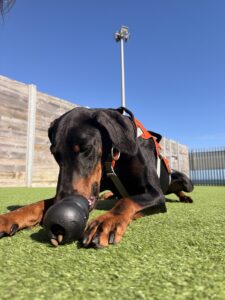
Why is enrichment important for dogs?
Enrichment activities are an important outlet for a dog’s natural behaviours. Sniffing, chewing, running, and playing are all important parts of a healthy, balanced lifestyle. If your dog doesn’t get enough of this kind of stimulation, this may result in frustration and unwanted behaviours.
Mental vs physical stimulation – which do dogs need most?
Both mental and physical stimulation are vital to a dog’s wellbeing, but there may be times when they need more of one than another.
For example, on hot summer days, it’s not safe to take your dog on big walks as they may be at risk of heat stroke. Dogs who are recovering from operations, or struggling with reactivity may not be able to be exercised as much as they would like either.
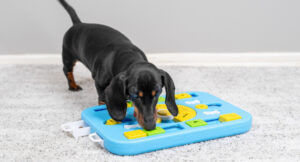
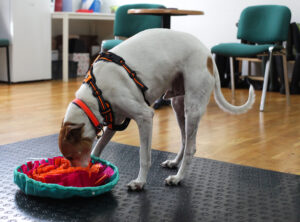
In these instances, giving your dog plenty of mental stimulation can be a great alternative. DIY snuffle mats or puzzle feeders are great ways to provide your dog with some indoor enrichment, training games are another fantastic option.

Trainer’s tip
When your dog can’t get out for a proper walk, don’t worry — ten minutes of nose work or a stuffed, frozen Kong can tire them out just as well as a long walk. A tired brain makes for a settled dog.
Vicky EDCH dog trainer
Different types of enrichment
A good way to provide a variety of enrichment activities is to think about ways to stimulate each of a dog’s senses. Some good options include:
Food enrichment
Food enrichment activities are an easy and cheap way to keep your dog entertained, slow down their eating, and provide mental stimulation.
Spreading dog safe peanut butter, meat paste or squeezy cheese over a lick-mat, or filling a rubber chew toy, like a Kong, and chucking it in the freezer for a few hours can keep them occupied for ages!
You could also make your own DIY snuffle mats, or create a food puzzle by hiding treats in a rolled up towel, or tossing treats into a box filled with shredded or scrunched up newspaper.
Be cautious if your dog is a chewer, and don’t leave them unsupervised with hard chews, or DIY feeders as these may pose a choking risk.
Sensory enrichment
A dog’s sense of smell is their strongest sense, it’s how they understand the world around them. For most dogs, scent training is a fun and engaging form of enrichment.
This could be as simple as letting them stop and sniff as much as they like on their regular walk, or walking them somewhere new with a variety of different smells like a woodland or long grass meadow. You can also do some scent work at home with treats or toys.
Find it
-
1
Name the toy
Every time you pick up their favourite toy, name it and say it out loud.
-
2
Hide it while they watch
Hide it somewhere easy while they’re watching so they know where it is, then ask them to ‘find it!’
-
3
Progress to trickier spots
Try this a few times until they get the hang of it, then you can progress to hiding the toy in trickier places.
-
4
Test them
Test them by hiding it among their other toys for an even bigger challenge!
Find it – treat version!
If your dog is more food motivated and less interested in toys, you can play the ‘find it’ game with treats instead.
-
1
Hide a few treats
Put your dog outside the room (or garden) and hide a few treats around.
-
2
Bring them in
Bring them in and say ‘find it’.
-
3
Guide if needed
You can guide them towards the first treat if needed and say the word as soon as they find it.
-
4
Let them learn
They’ll soon get the hang of it!
Scatter games
A super simple scent work game is to scatter their dinner or a handful of their favourite treats across the garden, and let them sniff out all the biscuits they can find!
Other sensory enrichment
At the Home, we often leave gentle music on in the kennels as another form of sensory enrichment.
Studies have shown that calming classical music can help dogs settle more quickly when their owners are not with them. Why not observe how your dog responds to some classical radio next time they’re feeling restless.
Physical enrichment
All dogs need plenty of physical exercise but for some breeds this will be more than others!
For particularly high-drive dogs, agility work can be a great energy burner. Breed specific activities like Barn Hunt games or flirt poles for terriers, which mimic hunting for rats or vermin can be a lot of fun.
Swimming, digging, and playdates with dog friends are all fantastic ways to tire out a high energy pup!
Other dogs will need less physical activity to satisfy their needs but every dog needs daily walks and regular opportunities to run and play.
Mental enrichment
Trick training and problem solving games are fantastic mental enrichment for curious and clever dogs.
Paws up trick
This is a quick and easy training game that you can try with your dog. Paws up teaches them to put their front paws on a stable object such as an upturned water bowl or a tree stump. This is a good way to get your dog’s attention back to you if they’re feeling overstimulated or not listening on a walk. It also makes for a great photo opportunity!
-
1
Lure them on
Choose the stable object you want your dog to put their paws on and use a treat to lure them on to it. If they place even one paw up, reward and repeat, they will soon get the idea!
-
2
Add the cue
As soon as they’re in the right position, say the cue word ‘paws up’ and give them the treat.
-
3
Drop the lure
Once they’ve done this a few times with the treat, try saying the cue without encouraging them up with the treat. Congratulate them and give them a treat if they do it!
Social enrichment
Dogs who are comfortable with other people and dogs will benefit from playdates with friends at a dog park, or they may enjoy visiting new places and watching the world go by.
Some of our dogs love to walk down Porty prom and run about on the beach with each other, enjoying the sights and sounds of the busy street.
Free Work enrichment for more anxious dogs
Free Work is a form of dog-led enrichment activity developed by the founder of ACE (Animal Centred Education), Sarah Fisher. It’s especially beneficial for older or more anxious dogs who are not able to go for big walks.
Setting up a free work station is easy and inexpensive, you can easily do it at home or in the garden.
- Place down a few different surface types for your dog to walk on, these could be tarpaulin, a yoga mat, carpet squares, or a towel.
- Try to include different levels by adding some kind of platform, this could be an overturned plastic crate or an aerobic step.
- Add a few enrichment items like a lick mat, a few toys, and scattered treats of different sizes and textures. You can also spread some squeezy cheese or dog-safe peanut butter on any easy to clean hard surfaces.
Once you’ve set up your free work space, simply let your dog in to explore in their own time. Observing them as they go will give you some insight into their likes, dislikes and favourite toys or treats.
Try not to encourage your dog towards any one part of the set up but let them explore entirely as they want to. This is a great way to provide low pressure enrichment for an anxious dog, and can even be used to help your dog decompress after stressful incidents like busy walks or a trip to the vet.
Safety considerations when giving your dog enrichment
It’s generally best to supervise your dog with their enrichment activities as chew toys can quickly become choking hazards if you’re not careful.
DIY toys made from cardboard or scrunched up paper can cause internal blockages if chewed up and ingested so it’s best to supervise your dog while playing!
Breed specific requirements
While every dog is an individual, there are breed traits which can impact the enrichment they need. Dogs with a high prey drive will need a lot more physical and mental stimulation than others. There are fun training games created to give different breeds a safe outlet for their natural behaviours. For example, herding breeds such as Collies might enjoy herding games such as Sheep Ball, and breeds like hounds or spaniels who love to use their nose will get a kick out of ManTrailing.
When welcoming a dog into your home, it’s important to consider if your lifestyle will be compatible with their common breed traits and if you will be able to meet their enrichment needs.
Final enrichment thoughts
No two dogs are the same and what might entertain one pup for hours could be utterly boring to another!
Have fun trying out various enrichment activities to get to know your dog’s personal preferences and offer them some form of enrichment every day.
More advice

How to help your dog with their fear of fireworks