Enrichment for cats
Why is enrichment important for cats?
One of the five welfare needs of animals is to be able to exhibit natural behaviours. For cats, this means climbing, hunting, hiding, and stalking.
Good cat enrichment helps pet cats explore their natural instincts, keeping them mentally healthy and reducing stress.
How much playtime and enrichment does a cat need?
How much playtime your cat needs is age dependent. Kittens and senior cats will sleep a lot more than adult cats and need a little bit less playtime as a result.
As a general rule, a healthy adult cat will need about half an hour of interactive playtime a day, in short bursts of 10 or 15 minutes at a time. Don’t encourage playtime straight after dinner to avoid indigestion. And don’t worry, they will let you know when they’re done with playtime!
However, when it comes to enrichment, there’s no limit! Cats will benefit from as much varied enrichment as you can give them.
Easy enrichment ideas to stimulate their senses
Playtime
In the wild, cats hunt various small prey such as mice or birds. Notice the way your cat interacts with their toys; do they prefer to sneak and chase toys dragged along the ground or leap into the air to catch them?
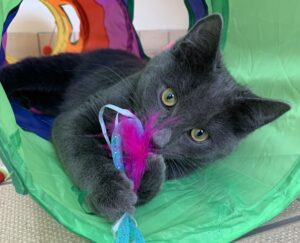
Cats usually like to play in short bursts throughout the day. Swap out toys as you play with them to provide variety and get to know their favourite games. Fishing rod style toys are good for mimicking mice and birds, but a ball of scrunched up tinfoil or newspaper can be equally fun.
Be careful not to give your cat anything they could swallow and regularly check their toys for signs of wear.
Food puzzles
Food puzzles are a great way to stimulate your cat’s brain and help them eat more slowly if they’re a scoffer!
These can be easily DIY-ed by poking holes in an empty toilet roll or by filling an empty egg box with some kibble.
Licky mats are another simple way to vary your cat’s mealtimes and provide entertainment for a hungry cat.
Scent and sight enrichment
Have you ever noticed your cat doing a bit of a ‘sniff inspection’ of the shopping as you unpack it, or making a little ‘ekek’ noise as they watch birds outside the window?
Cats are curious about their environment and it’s important to give them opportunities to explore it. This is especially true for indoor cats who experience less variety in their day-to-day life.
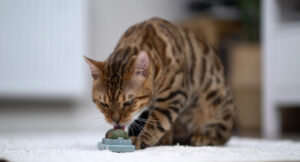
Stimulate their sense of smell with catnip toys or by simply opening the window to let them hear the birds and sniff the air – watch they can’t climb out onto the roof though!
Environmental enrichment
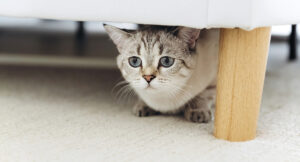
Cats like to climb and hide. Make sure your cat has access to resting spots where they can perch up high and look down over the room. This could be a cat tree or even creating space for them to hop up onto tall cabinets. Just make sure it’s sturdy and secure for them!
Also ensure your cat has small dark dens to hide away in. A cardboard box with a hole cut in its side makes a fantastic makeshift den.
Cats have a natural desire to maintain their claws by scratching. Spare your soft furnishings by giving them a scratch post or rough surfaces for them to dig their claws into.
Social enrichment
Cats may have a reputation for being a little aloof, but they need quality time with their owners.
Spending time playing with your cat, grooming their fur and cuddling is an important part of keeping them happy and healthy.
Do outdoor cats still need enrichment?
Outdoor cats will get a lot of stimulation and enrichment from their adventures, but they still benefit from enrichment activities when they come home.
Scratching posts, hiding spots and climbing areas are especially important to give your cat the mental stimulation they need at home.
Interactive playtime with your cat’s favourite toys also helps to build a bond between you.
Enrichment for older or more nervous cats
If your cat is older or more nervous, they may not want a lot of high energy play or enrichment. Try engaging in some more gentle play by moving their toy around more slowly so that it’s easier for them to catch.
Lick mats are another great, calm, hands-off enrichment activity. And they may find that a scratch board, which you can lay on the floor, is more comfortable for a senior cat than a tall, stiff scratch post.
Safety tips for enrichment
When leaving a cat alone with any enrichment activities, you need to be aware of the safety considerations.
Don’t leave them unsupervised with catnip toys which could become overstimulating, or any soft toy with bits that could be torn off, like a mouse toy with a tail.
If you know your cat is a big chewer, you might also want to be careful leaving them with really hard plastic toys that could damage their teeth.
Finally, don’t leave enthusiastic treat-lovers alone with a lick mat as they may chew it to bits!
More advice
Litter trays