Dogs and growing families
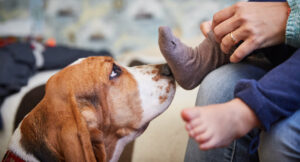
Why might a dog find it difficult when a new baby arrives?
A new baby brings with them a lot of new smells, noises, and sometimes a lot more visitors too. This can be overwhelming for a dog as they often depend on routine for comfort and security.
It can take some time for them to adjust to these changes.
Step-by-step training tips to prepare for the upcoming change
Before the baby arrives, there are some ways you can help your dog to prepare for their new sibling.
Train positive associations
Get your dog used to all the new equipment that comes with a baby by building up your cot, pram, car seat etc. as you buy them. Don’t set them up all at once, but gradually introduce these new items and let your dog get used to them being in the house.
When they’re relaxed with the pram around the house, you might even want to take them for a walk with it. It will make for a far less stressful experience on your first walk with the baby if you already know that your dog is going to behave!
You can also play baby crying sounds around the house while your dog is playing with their favourite toy or enjoying a chew. Start at a low level so as not to immediately stress them out and gradually increase the volume over time if they’re not worried about it.
If they do become stressed by the sounds, let them decompress in another room with their favourite enrichment like a chew or a lick mat.

Help them adjust to a changing routine
When your baby comes, you probably won’t have enough time or energy to walk your dog as much as you do right now, or give them quite as much attention!
Help them adjust to their new life by slowly introducing some changes now. Take them for shorter walks and introduce them to any new shorter routes you might like.
If you’re reducing your dog’s walking time, it’s important to increase at home enrichment activities so that they still get enough daily stimulation.
A chew toy filled with their favourite spreadable snack and frozen can give them satisfying entertainment for a while. You can easily DIY other food puzzles, check out our article on enrichment for more inspiration.
How to teach ‘settle’
Teaching your dog to ‘settle’ is a great tool to help them decompress in stressful situations. Here’s how you can introduce this.
Teaching ‘settle’
-
1
Choose the spot
Choose a dog bed, mat, crate, or wherever you want them to associate with the command. Start in a quiet environment with no distractions.
-
2
Create a happy association
Start by tossing a few treats over towards the bed and when they investigate keep going with the treats to try and create a happy association.
-
3
Reward lying down
Ask them to lie down and reward when they do, even if it’s just for a few seconds.
-
4
Capture it
If they take themselves to the bed outside of training, capture and reward it by offering a treat.
-
5
Choose your cue
Once they’re settling on the bed, choose your own cue word and stick with it. This could be ‘settle’ or ‘bed’. Reward them every time they respond like you want them to.
-
6
Build up the time
Increase the time between their settling and the reward, start with a few seconds and slowly build up.
-
7
Ignore the wobbles
If they get up and become unsettled, ignore them and don’t reward until they settle again.
-
8
Add distance
Once they’re consistently settling on cue, you can practice standing up, moving away and rewarding when they stay settled. Build slowly towards leaving the room and rewarding if they stay settled.
-
9
Add distractions
If the goal is for them to settle out and about you can introduce more distractions, or practice asking them to settle in busier environments.
Settling on their bed should be an enjoyable thing for your dog. Watch their body language for indications that they’re relaxed and help them have a good time by offering their favourite chews or toys while they’re lying in their settle spot.
Short training spells little and often helps to keep their attention and maintain their interest. Don’t worry if you feel that you’ve moved on too fast, simply return to the step that your dog is responding to and start building your progress again from there.
Signs of relaxation in dogs
When teaching ‘settle’, here are some indications that your dog is relaxed and comfortable:
- Lying down
- Lying with their chin down
- Flopping over on their side
- Sighing
- Weight shifting
- No tension in their face or body language
Recognising signs of stress
These could be signs that your dog is a little stressed around the baby.
-
Moving away
Your dog moves away every time the baby cries.
-
Steering clear
They generally steer well clear of the baby.
-
Sudden behaviour changes
Like resource guarding, or stopping eating.
What to do if your dog is stressed around the baby
If your dog is showing signs of stress around your baby, don’t panic. Keep your dog separate from your baby, either behind a baby gate or in another room. Make sure your dog is still getting some exercise and enrichment, as they’re adjusting to not being the centre of attention anymore!
Give your dog a positive distraction like one of their favourite enrichment toys. You might want to have a few chew toys, like a Kong, filled with their favourite dog-safe spread ready in the freezer for moments like this!
Don’t just lock the dog away when they’re stressed by the baby as this might lead to more anxiety for your pet. Instead try to remove yourself and the baby and encourage your dog to settle in their protected safe place.
If you have friends or family who you feel comfortable asking, it might help to have some support walking your dog during this early stage. This will help ensure your dog gets all the enrichment they need while you all adjust to your new life!
Setting important boundaries with young children and dogs
As your children grow up, it’s vital to establish some basic boundaries around any pets to help keep them, and your dog safe. Here are some clear and important boundaries that we recommend:
Boundaries we keep
- The dog’s crate is a safe space for them and totally off limits for anyone else.
- When the dog is eating, playing with a toy, or chewing a treat, we leave them alone.
- When the dog’s sleeping or resting, we leave them alone.
Things we never do
- We never run up to any dog, and we never pet a dog without asking the owner first.
- We don’t wrap our arms around a dog to give them a cuddle, and we leave it to the adults to check their ears or teeth if they need it.
- We don’t take the dog for a walk without an adult’s help.
- We never play with the dog when an adult’s not around.
Teaching children to interact safely with dogs
Kids don’t know how to read a dog’s emotion and this can lead to dangerous situations if we’re not careful. Teach your children how to spot signs of stress from an early age and stress the importance of respecting a dog’s space. We recommend that children are never left unsupervised with dogs – even if your dog is the friendliest pup you know, they only have so much patience!
More advice